Fractional CMO services: what they cost, and when a business is actually ready
Senior marketing leadership on a retainer, delivered directly by Branden Bodendorfer. Here is the honest version of what that means, what it costs, and when it's the wrong call.
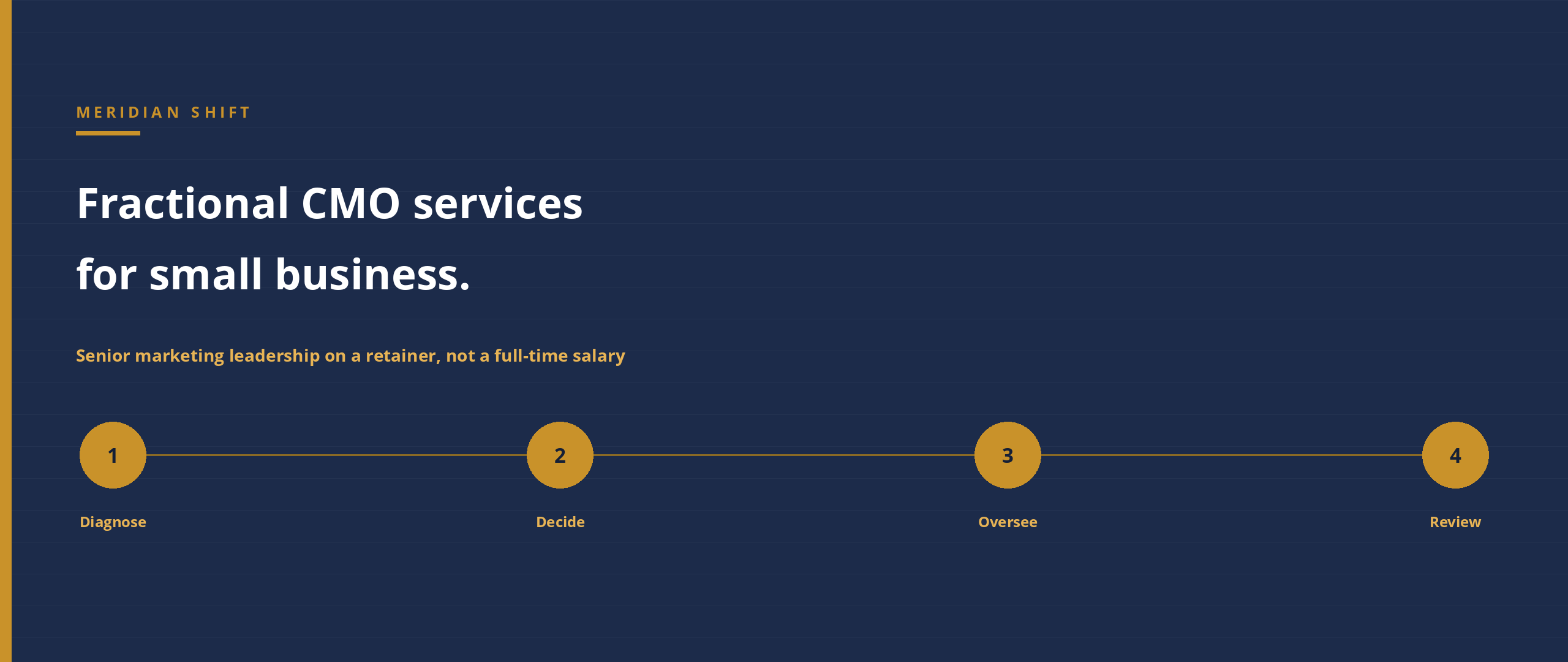
Fractional CMO services give a business senior marketing leadership on a part-time retainer instead of a full-time executive hire. A fractional CMO owns the marketing strategy, sets the priorities, holds the budget accountable, and manages whoever executes. Typical engagements run monthly and cost a fraction of a full-time CMO salary. The role fits businesses that have outgrown the owner doing marketing in the evenings but cannot yet justify a six-figure executive.
What a fractional CMO actually does
The title gets used loosely, so here's the line that matters. A fractional CMO owns the marketing number. Not the tactics, not the calendar, the number.
That ownership shows up in four places. Strategy: deciding which markets, which messages, and which channels get funded. Budget: saying no to the things that feel productive and cost money. Accountability: running a cadence where results get looked at honestly. Oversight: managing the people or vendors doing the execution.
What a fractional CMO is generally not is the person writing every blog post and building every landing page. Some do execute, especially at smaller companies, and this engagement does. But if execution is all you need, you don't need a CMO of any kind. You need a contractor, and it'll cost less.
Fractional CMO vs agency vs full-time hire
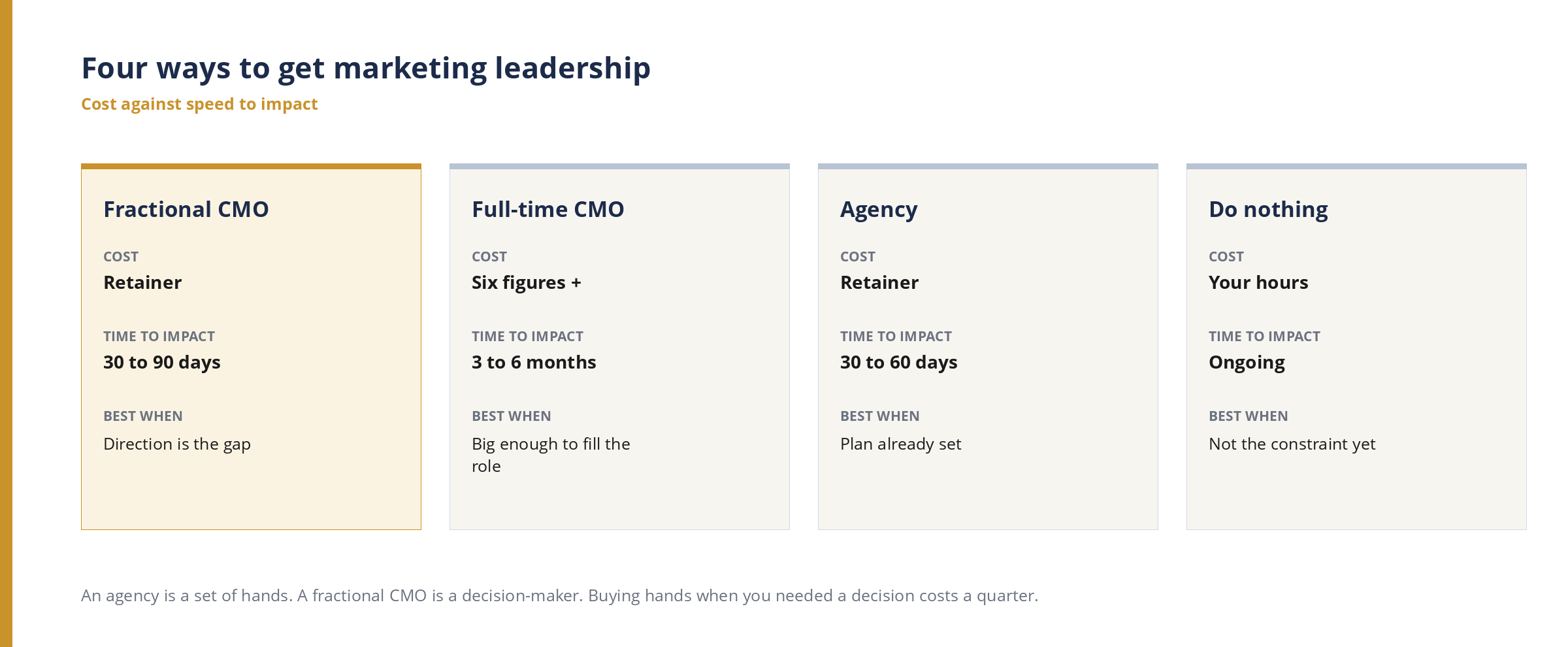
Most businesses weighing this are really choosing between four options. Here's how they compare on the things that decide it.
| Option | Typical cost | Time to impact | Best for | Main risk |
|---|---|---|---|---|
| Fractional CMO | Monthly retainer, a fraction of an executive salary | 30 to 90 days | 5 to 50 people, no senior marketer, direction is the gap | Limited hours. Wrong fit if you need heavy execution volume |
| Full-time CMO | Six-figure salary plus benefits and equity | 3 to 6 months including hiring and ramp | Companies large enough to keep an executive genuinely busy | Expensive to get wrong, slow to unwind |
| Agency retainer | Monthly, often comparable to a fractional retainer | 30 to 60 days on execution | You already know the strategy and need output volume | Agencies execute a plan. They rarely tell you the plan is wrong |
| Owner keeps doing it | No invoice. Real cost is your hours | Ongoing | Pre-revenue, or marketing genuinely isn't the constraint yet | Plateaus quietly. Usually the reason people start looking |
The honest read: an agency and a fractional CMO are not competitors. An agency is a set of hands. The other is a decision-maker. Businesses that buy hands when they needed a decision-maker end up with excellent execution of a strategy nobody validated.
What fractional CMO services cost
Pricing depends on scope and hours, and anyone who quotes a number before understanding the business is guessing. What can be said honestly is the structure.
Fractional CMO work is a monthly retainer, sized to a set number of hours and a defined scope. It is not hourly, because hourly incentivizes the wrong things on both sides. It is not project-based, because leadership isn't a project.
The comparison that actually matters is not retainer versus retainer. It's the retainer against a full-time CMO's total cost, which includes salary, benefits, payroll tax, equity, recruiting fees, and the ramp time before that person produces anything. Fractional CMO services exist because that total is out of reach for most businesses under fifty people, and often out of proportion to the work available.
Pricing gets discussed on the first call, once there's a real scope to price. That call is free and there's no obligation attached to it.
Five signals a business is ready
Not everyone asking about this needs one. These are the patterns that usually mean yes.
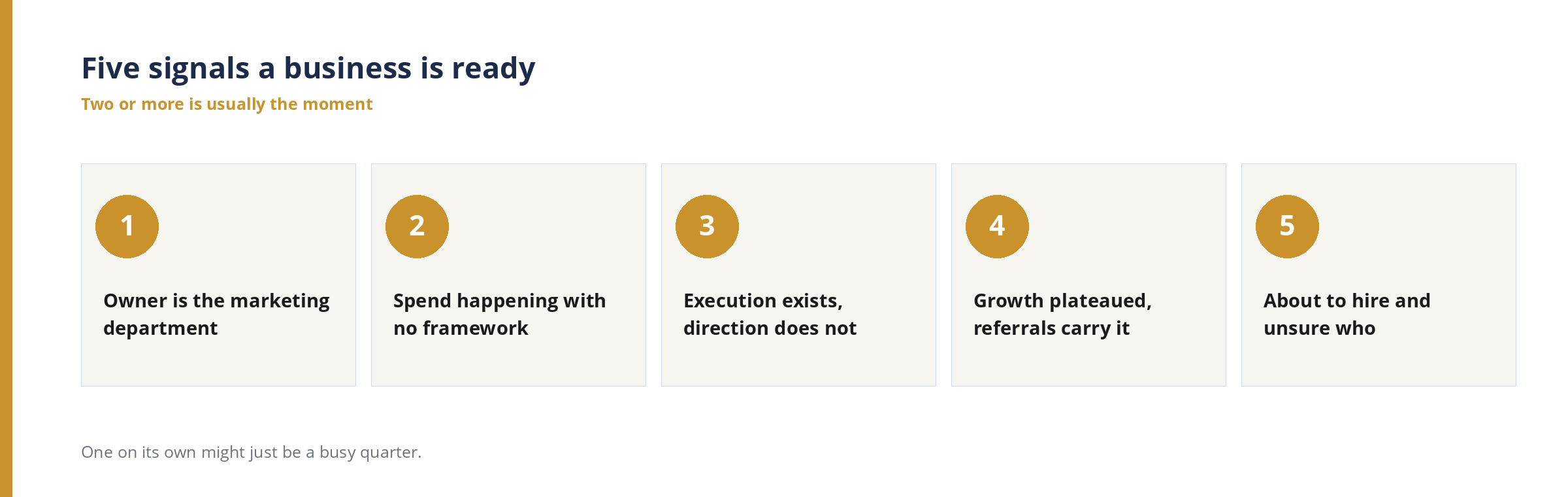
- The owner is the marketing department. Strategy happens at 9pm, between everything else, and it shows.
- Spend is happening without a framework. There's a budget going out the door and no honest answer to which part of it works.
- You have execution but no direction. A contractor, an agency, or a junior marketer is producing work, and nobody senior is deciding whether it's the right work.
- Growth has plateaued and referrals carry the business. Referrals are wonderful and they are not a growth channel you control.
- You are about to hire a marketing person and don't know which one. This is the cheapest possible moment to get senior input, and the most common one to skip.
Two or more of those and fractional CMO services are probably worth a thirty-minute conversation. One on its own is more often a busy quarter than a structural problem.
How this engagement runs
Every provider structures this differently. Here is how fractional CMO services work at Meridian Shift, so you can compare against whoever else you are talking to.
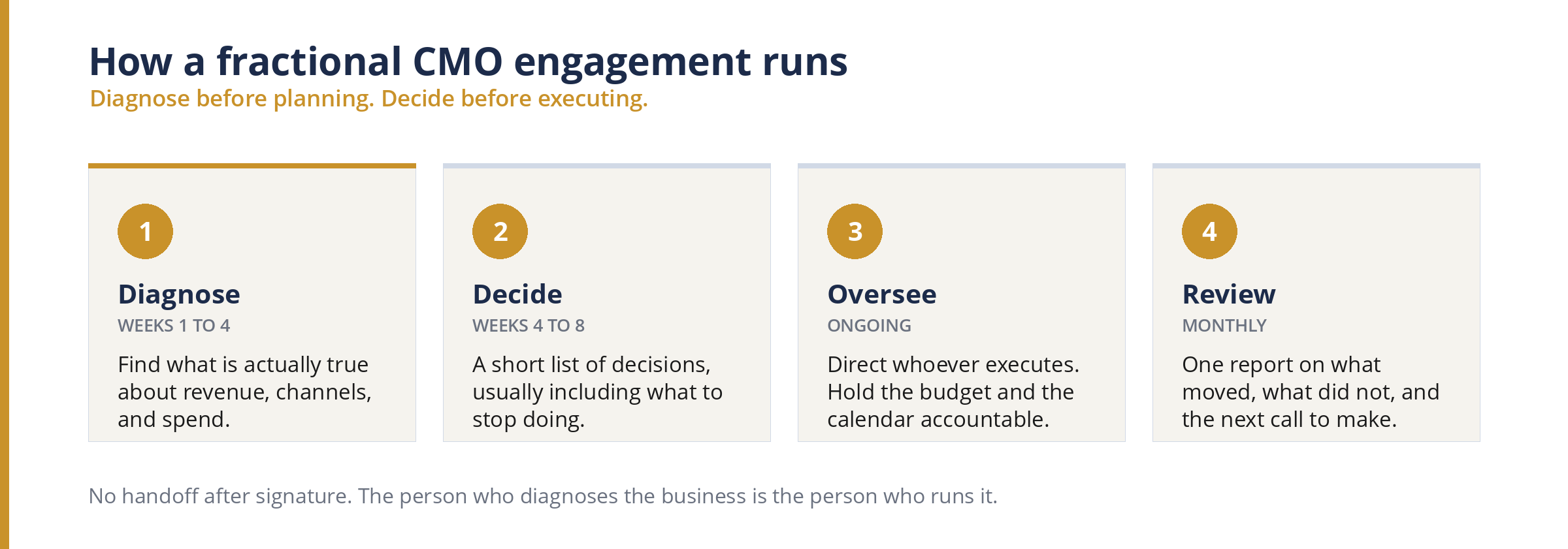
You work with Branden Bodendorfer directly. Not a strategist reporting to a director reporting to a partner you met once in the pitch. There is no handoff after signature because there is nobody to hand off to. That's the model, and it's also the limit on how many clients Meridian Shift takes.
Engagements start with a diagnostic rather than a plan. The first job is finding out what's actually true about the business: where revenue comes from now, which channels are earning their spend, and what the owner believes that the data doesn't support. That last one takes the longest.
Then a short list of decisions, usually including what to stop. Most businesses arriving here are doing too many things adequately rather than a few things properly. Subtraction tends to produce the first visible win.
After that it's a monthly cadence: priorities set, work overseen, numbers reviewed honestly, and course corrections made while they're still cheap.
One thing worth saying plainly. Branden has been in business development and marketing since 2004, has worked with more than 2,000 businesses, and currently runs Key2Success Planner, a product business with customers in over 52 countries. The marketing advice comes from somebody who owns a profit and loss statement right now, not from somebody who owned one a decade ago.
Who this is not for
Worth being direct, because a bad fit wastes everyone's quarter. Fractional CMO services are not the right answer for three groups in particular.
Pre-revenue companies that need a brand built from nothing on a startup budget are usually better served by a contractor and their own judgment. Large organizations that already have a marketing team and need execution capacity need an agency, not another strategist. And any business that wants a fifteen-person team running nine channels simultaneously should hire an agency, and would rather know that on the first call than in the third month.
Questions people actually ask
What does a fractional CMO do?
Owns marketing strategy, sets priorities, holds the budget accountable, and oversees whoever executes. In practice: decides what gets funded, decides what stops, and runs the cadence where results are reviewed honestly.
How much does a fractional CMO cost?
A monthly retainer sized to scope and hours, materially less than a full-time CMO's total cost once salary, benefits, payroll tax, equity, and recruiting are counted. Exact pricing comes after a scope conversation, because a number quoted before that is a guess.
How does a fractional CMO work day to day?
A set monthly cadence rather than daily presence. Priorities get set, execution gets overseen, numbers get reviewed, and adjustments happen monthly instead of quarterly.
When should you hire a fractional CMO?
When direction is the gap rather than output. If the business has someone producing marketing work but nobody senior deciding whether it's the right work, that's the moment.
Should I hire a fractional CMO or a full-time CMO?
Ask whether a full-time executive would have enough genuinely executive work to fill their week. Under about fifty people the answer is usually no, and you'd be paying a senior salary for work a mid-level marketer could do.
How do I choose between in-house marketing and a fractional CMO?
In-house gives you hours and availability. A fractional CMO gives you judgment and pattern recognition from many businesses. If you already have hours and results are still flat, you need judgment. If you have a clear plan and nobody to run it, you need hours.
How is this different from hiring an agency?
An agency executes a plan. This role decides the plan, then holds the agency accountable to it. Plenty of businesses need both, and the order matters.
How long does a fractional CMO engagement last?
Long enough for a strategy to be set, tested, and corrected, which realistically means months rather than weeks. Anything shorter is a consulting project wearing a different name.
Why hire a fractional CMO instead of a consultant?
A consultant hands you a recommendation, then leaves. This role stays and owns whether it works. The difference shows up in month three.
Who needs a fractional CMO?
Typically businesses between five and fifty people, past the referral stage, with marketing spend happening and no senior person setting direction.
What does fractional actually mean here?
Part of a full-time role, on a retainer. You get senior capability for a share of the week rather than a junior full-time hire for all of it.
How competitive is the fractional CMO market?
Crowded, and quality varies a lot. The useful filter is operating experience: ask what the person has personally built and owned, rather than only advised on.
Wider reading on the marketing leadership role itself: the American Marketing Association publishes ongoing research on how the CMO function is changing.
Find out whether you actually need one.
Thirty free minutes with Branden. If a fractional CMO is the wrong answer for where your business is, he'll say so on that call.