Marketing strategy services: what you get, what it costs, and when you need one
Strategy is the decision about what to do and what to stop. Here is what that work actually involves, priced honestly, from someone who has run it inside more than 2,000 businesses since 2004.
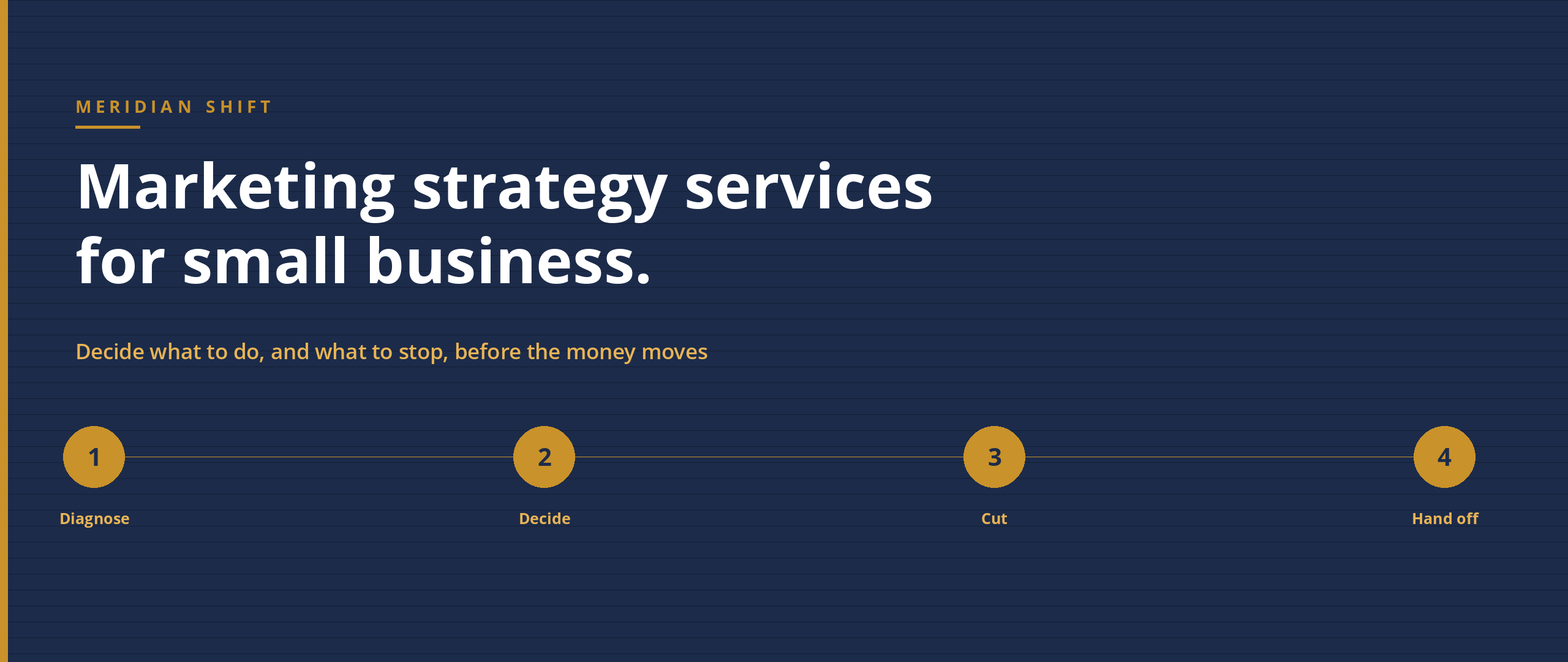
Marketing strategy services define what a business should market, to whom, through which channels, and in what order, before any money goes into execution. A strategy engagement produces a written plan: the positioning, the priority audience, the channel mix with budget attached, the metrics that count, and the list of activities to stop. Most engagements run four to eight weeks and cost less than one quarter of misdirected ad spend. The work fits businesses that are already spending on marketing without an honest answer to which part of it works.
What the work actually includes
The word gets used for everything from a one-page mission statement to a hundred-slide deck nobody opens twice. Here is the working definition: strategy is the set of decisions that determine where effort goes, and those decisions are only real if something gets cut. Five things come out of the engagement.
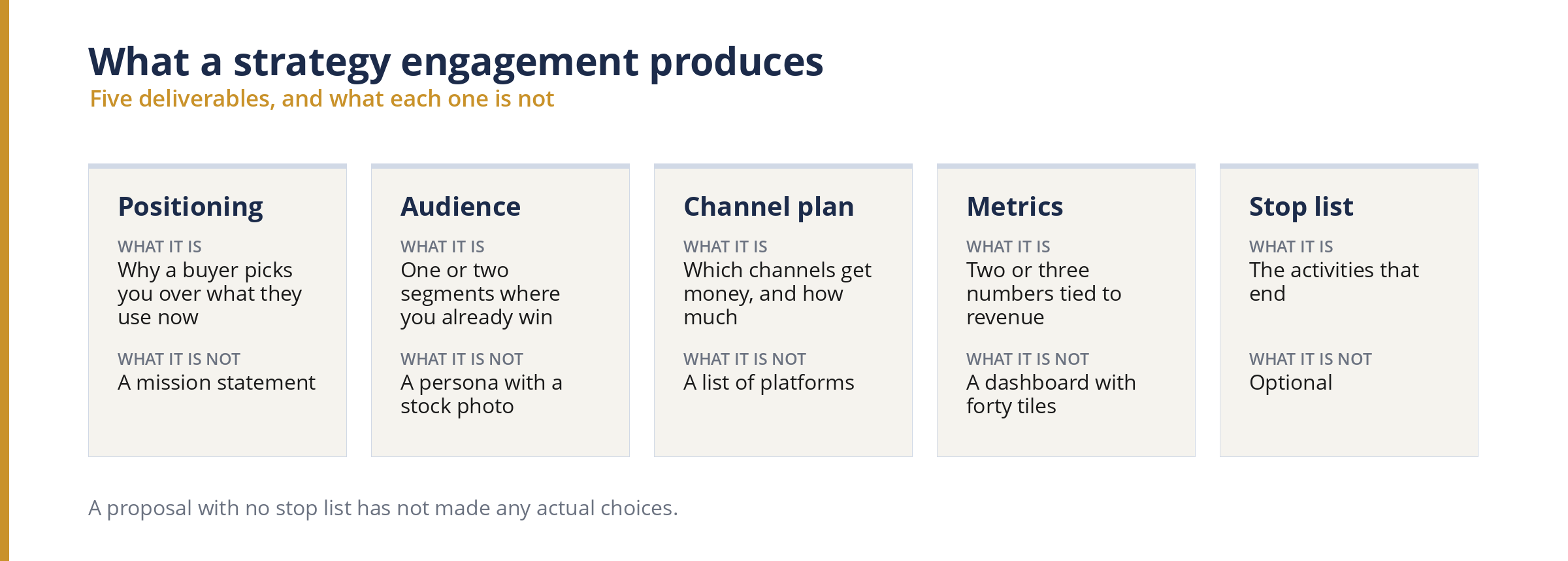
Positioning. What the business is, who it is for, and why a buyer would pick it over the alternative they are currently choosing. Most of this work is subtraction. The average business says four things about itself that no customer has ever cared about.
A priority audience. Not a persona document with a stock photo and a fake name. One or two segments where the business already wins, plus the honest reason it wins there.
A channel plan with budget attached. Which channels get money, how much, and what each one is expected to produce. A channel list without dollars beside it is a wish list.
Metrics that mean something. Two or three numbers tied to revenue, not a dashboard with forty tiles. Impressions are not a metric. Booked calls are.
A stop list. The activities that end. This is the part clients push back on and the part that produces the first visible improvement.
Strategy against execution, and the cost of buying the wrong one
Businesses shopping for help are usually choosing between four things without realizing they are different purchases.
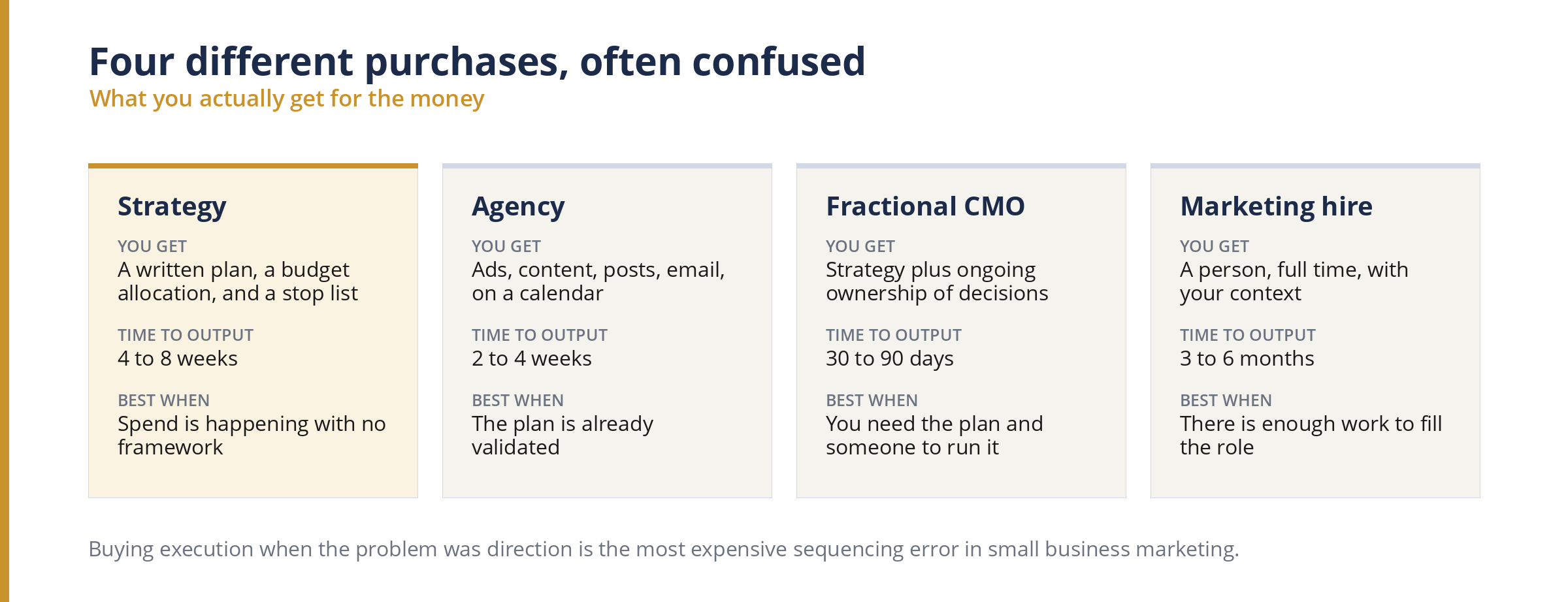
| What you buy | What you get | Time to first output | Best when | Main risk |
|---|---|---|---|---|
| Strategy engagement | A written plan, a budget allocation, and a stop list | 4 to 8 weeks | Spend is happening with no framework behind it | A plan nobody executes. Ask who owns it on day one |
| Execution agency | Ads, content, posts, email, produced on a calendar | 2 to 4 weeks | The plan is already set and validated | Excellent output pointed at the wrong target |
| Fractional CMO | Strategy plus ongoing ownership of the decisions | 30 to 90 days | You need the plan and someone to run it | Costs more than a one-time plan, because it is more |
| Marketing hire | A person, full time, with your context in their head | 3 to 6 months including hiring | There is enough work to fill the role properly | Hiring for execution when you needed judgment |
The expensive mistake is buying execution when the problem was direction. An agency will happily produce twelve months of content against a positioning nobody validated, and both parties will be busy the whole time. If you already need the plan owned month to month rather than handed over, that is fractional CMO work instead.
What marketing strategy services cost
Anyone quoting a number before understanding the business is guessing, so here is the structure instead of a fake price.
Strategy work is scoped as a fixed-fee project, not hourly and not a retainer. The deliverable is defined, so the client should not be paying for the time it takes to think. Hourly billing on strategy rewards slowness on one side and rushing on the other.
The number depends on three things: how many revenue lines the business runs, whether usable data exists or has to be reconstructed, and how many people need to agree at the end. A single-location business with clean analytics is a different project from a four-division company where nobody agrees what the flagship product is.
The comparison worth making is not one firm's fee against another's. It is the fee against a quarter of misdirected spend. A business putting $8,000 a month into channels chosen by habit is risking $24,000 a quarter on an untested assumption. Marketing strategy services cost a fraction of that, and the output either confirms the current approach or redirects it. Both outcomes are worth more than the invoice.
Pricing gets discussed on the first call, once there is a real scope to price. That call is free and nothing is attached to it.
Five signs strategy is the missing piece
Plenty of businesses asking about this do not need it yet. These are the patterns that usually mean the gap is direction rather than output.
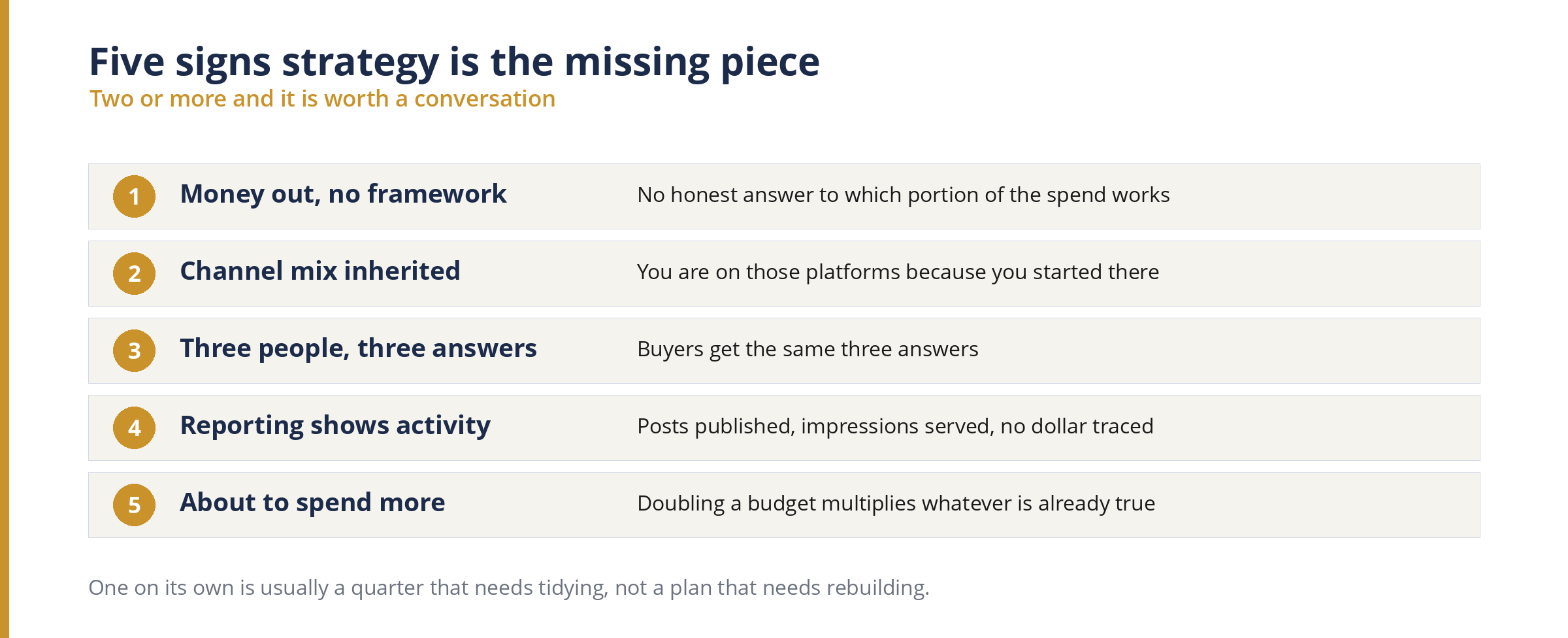
- Money is going out with no framework behind it. There is a budget being spent and no honest answer to which portion of it works.
- The channel mix was inherited, not chosen. You are on the platforms you are on because you started there, or because a competitor is there.
- Everyone in the building describes the business differently. Ask three people what you do and get three answers. Buyers get the same three answers.
- Reporting shows activity, not outcomes. The monthly report is full of posts published and impressions served, and nobody can trace a dollar back through it.
- You are about to spend meaningfully more. Doubling a budget multiplies whatever is already true, including the parts that are wrong.
Two or more of those and a strategy engagement is probably worth a conversation. One on its own is often just a quarter that needs tidying, not a plan that needs rebuilding.
How the engagement runs
Every firm structures this differently, so here is the shape of it at Meridian Shift, laid out so you can compare it against whoever else you are talking to.
You work with Branden Bodendorfer directly. Not a junior strategist reporting to a director reporting to the partner who ran the pitch. No handoff after signature, because there is nobody to hand off to.
The first phase is diagnostic, not planning. Where does revenue actually come from, which channels are earning their spend, and what does the business believe that the data does not support. That last question takes the longest and produces the most.
Then the decisions, written down, with the stop list included. A plan that only adds work is not a plan, it is a wish list with a budget attached.
Then a working session to pressure test it with whoever has to execute it. Plans die in the gap between the document and the person doing the work, and the fix is having that person in the room while it is still changeable.
You leave with a document you can hand to an agency, an employee, or a contractor, and a short list of numbers to watch. If you would rather someone own the plan going forward instead of receiving it, say so on the first call.
One thing worth saying plainly. Branden has been in business development and marketing since 2004, has worked with more than 2,000 businesses, and currently runs Key2Success Planner, a product business with customers in over 52 countries. The strategy advice comes from somebody who owns a profit and loss statement right now, not from somebody who owned one a decade ago.
Who this is not for
Being direct about the bad fits, because a mismatch wastes everyone's quarter. Marketing strategy services are the wrong purchase for three groups in particular.
Pre-revenue companies with no customers yet do not need a strategy engagement. They need to sell something to somebody and find out what happens. Strategy without a single data point is just opinion with formatting.
Businesses with a clear, agreed plan that simply need more output should buy execution capacity, not another document. And anyone hoping a plan substitutes for the discipline of following one will be disappointed, expensively. The engagement produces decisions. Somebody still has to keep them.
Questions people actually ask
What does a marketing consultant do?
Decides where marketing effort and money should go, then makes the case for it in writing. That means auditing what exists, cutting what does not work, choosing the channels and the message, and defining how success gets measured. A consultant makes decisions. An agency executes them.
How much do marketing consultants charge?
Strategy projects are typically fixed fee, scoped to the deliverable rather than the hours. Ongoing advisory work is usually a monthly retainer. Anyone quoting either number before understanding your revenue lines, your data quality, and your sign-off chain is guessing.
How much should I pay a marketing consultant?
Compare the fee against what the decision is worth, not against other quotes. If the business is spending $8,000 a month on channels chosen by habit, a quarter of that is $24,000 riding on an untested assumption. Price the engagement against that number and the math usually answers itself.
What is included in marketing strategy services?
Positioning, a priority audience, a channel plan with budget allocated to each channel, two or three metrics tied to revenue, and a list of activities to stop. If a proposal is missing the stop list, ask why. Strategy that only adds work has not made any actual choices.
How long does a marketing strategy engagement take?
Four to eight weeks for most businesses. Faster than that usually means the diagnostic got skipped. Much slower usually means the scope kept growing, which is a scoping failure rather than a thoroughness win.
How do I hire a marketing consultant?
Ask three questions on the first call. What will you tell me to stop doing? Who does the work, you or somebody I have not met? And what does the finished deliverable actually look like? Vague answers to any of those are the whole answer.
What makes a good marketing consultant?
Willingness to say no. The useful ones tell you which of your ideas is wrong, which channel to abandon, and when the honest answer is that marketing is not your constraint. A consultant who agrees with everything is selling comfort.
Do I need marketing strategy services or an agency?
If you cannot say which channel is earning its spend, you need strategy. If you know exactly what to do and lack the hands to do it, you need an agency. Buying the second when you needed the first is the most common and most expensive sequencing error in small business marketing.
What is the difference between marketing strategy consulting and a fractional CMO?
A strategy engagement is a project with a deliverable and an end date. A fractional CMO owns the decisions month to month and holds the budget accountable. Same thinking, different duration and different accountability.
Can a marketing consultant work without knowing SEO?
Some do, and it shows. Search is now where most buying research starts, and increasingly where AI assistants source their answers. A strategist who cannot evaluate whether search is a viable channel for your business is missing a channel, not merely a skill.
Will I get a document or a slide deck?
A document. Decks are built to be presented and are close to useless six months later when a new hire needs to understand why the plan is the plan. The deliverable here is written so somebody who was not in the room can act on it.
What happens after the engagement ends?
You execute it, with your team, an agency, or a contractor. Some clients come back for a quarterly review, some ask for ongoing ownership, and some take the document and run. All three are fine outcomes. The plan is yours.
Wider reading on the discipline itself: the American Marketing Association publishes ongoing research on how marketing planning and measurement practice is changing.
Find out whether strategy is actually your gap.
Thirty free minutes with Branden. If the honest answer is that you need execution rather than a plan, he will say so on that call.